Tuesday, March 6, 2012

The Big Cheese


Opposite Seattle's Pike Public Market, Beecher's Handmade Cheese showcases their process through wrap-around storefront windows.  Giant vats containing hundreds of gallons of milk are transformed into cheese curds.
Re-visiting the place over the course of my stay in Seattle, I not only came to appreciate what a curd is (more on that later), but the simple dedication the task requires to repeat the process every day in front of watching crowds.
A curdling agent, such as rennet, is added to the milk. Then begins the long process of separating the curds from the whey (solids from liquids).  The resulting chunks have a clean, tangy, flavor.
When I asked about its melting properties, visa-vie pizza, a salesperson said that the curds will soften and stretch but will not spread and drip.
Storefront 'micro-factories' such as this have the advantage of visually drawing people who otherwise might pass a sign that read "CURDS".  Like olive oil and vinegar shops, a tasting line further gets people to cross that essential line that brings them closer to buying and using the product.
Micro-breweries have used this to great advantage.  The storefront windows present the physical and metaphoric spirit of 'transparency' for industries.
Wood-fired brick oven pizzerias use this up-front prep and cooking area to great advantage.
At the risk of sounding anachronistic, ALL manufacture once had this transparency.  It's the modern version of the village shoemaker.
For previous blog on cheese production see: truebrickovens.blogspot.com/2011/01/cheese.html

Monday, March 5, 2012

Brick Oven Catering


On my last day and last evening in Seattle, Washington, I happened upon a small company catering an event with a simple but well-appointed portable wood-fired oven.
These terracotta ovens, built by Veraci Pizza's Marshall Jett are simple barrel domes with firebrick floors.  The fire gets the masonry hot, the live fire (addition of small amount of wood) keeps the interior blazing (My infrared pyrometer read 681F on the floor and 758F on the dome).  The oven is uninsulated so it cools down quickly (relative to the 30 hour cool-down of my insulated ovens) but it's compact and easy to build.

Olson Kundig Architects' "Mushroom Farm" http://www.olsonkundigarchitects.com/Projects/2195/Mushroom-Farm
 near Seattle's Pioneer Square hosted a pizza event on Saturday evening, March 3.
At 5pm, Veraci Pizza, which operates a half dozen portable ovens for such lively events was parked by the curb stoking the oven in preparation for the mushroom sampling.
Incidentally,  I have found that wherever I travel, being a builder and baker of wood-fired ovens creates a willing bond with fellow artisans. Marshall invited me to stay around for a slice of pizza.
Grazie


Saturday, March 3, 2012

Brick Ovens without Boundaries #3

Many years ago I sailed into a tiny harbor in the Bahamas.  Conch shells from ten generations of inhabitants were wind-rowed along the shore.  The extended family that lived on the island baked bread for passing sailors.  The four loaves we purchased from them never had a chance to cool off.

That is, we woofed them with generous slathering of butter...

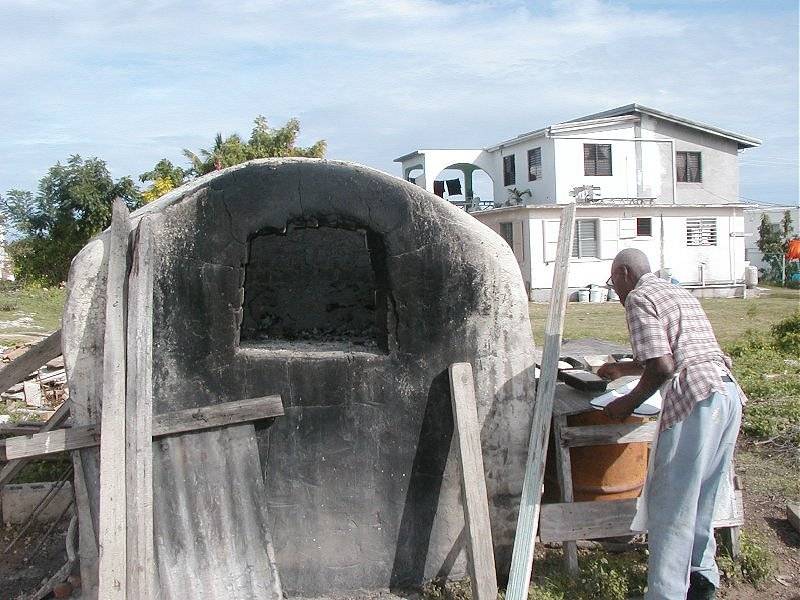
Ten years ago the man shown below baked bread for his family.  Remarkably, I have met elders in Italy, France, and the U.S. who take pleasure and give pleasure baking for their family.

Having an oven of my own, I may one day be known for that too.


Tuesday, December 23, 2003  news.ai


Bread from a Stone Oven click to enlarge
I had the pleasure of seeing the workings of one of the Caribbean's dying traditions in the village of North Hill...baking bread in a stone oven.
click to enlarge click to enlarge
The stone oven is the predecessor of today's gas/electric oven, often cooking bread just as quickly (in 45 minutes to an hour) and definitely with more flavour. This stone oven is constructed of a thick layer of cement blocks and mortar on the exterior and bricks on the interior. The oven has a hole on the side which is lightly covered on the outside by some galvanized tin held up by sticks.
click to enlarge
Wood is placed in the oven and lit and allowed to burn for some time...usually a couple of hours. Then after the oven is hot enough, the burning coals are discarded of through the hole on the side. The cleaning effort is done with pointed sticks of different lengths, dipped in water just before and just after pushing the coal out.
click to enlarge
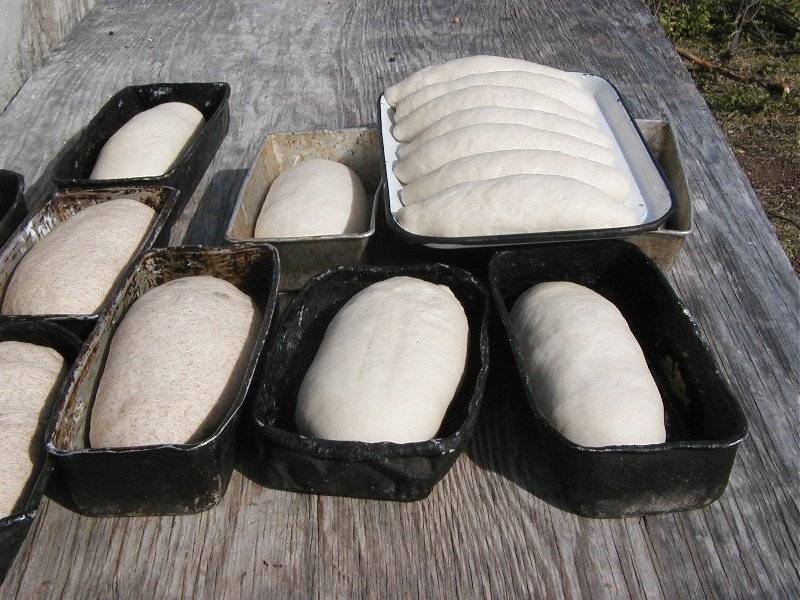
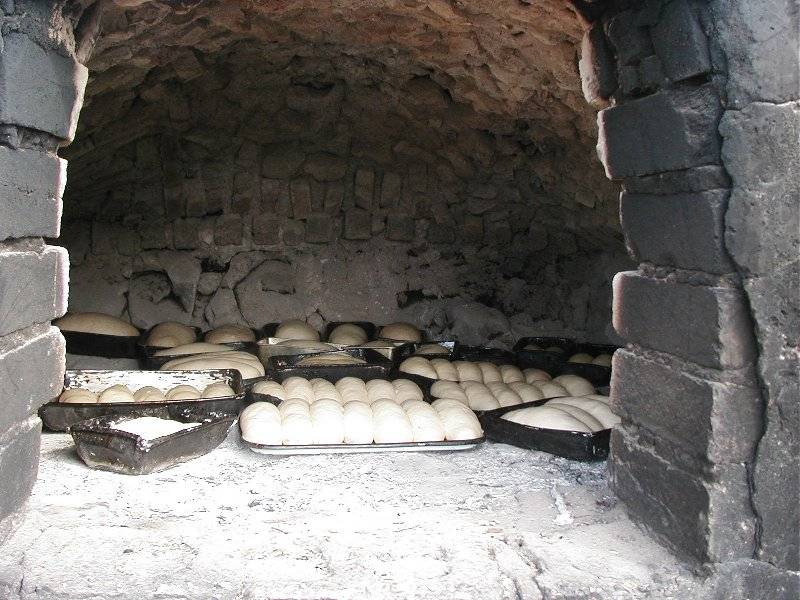
The oven needs to be clear of burning wood before the bread is put in or else this would lead to buring of the bread. The bread is placed in on flattened wood sticks, with the larger loaves set at the back, the part that retains the most heat. After the loaves are in, the front of the oven is shut with a piece of galvanized tin held up by pieces of wood on the exterior. An hour or so later, delicious loaves will make a treat for the baker's family and friends. (Not for sale commercially.)

Friday, March 2, 2012

Brick Oven Styling

Makers of home gas and electric ranges are conscious of the place they will occupy in the household's practical and decorative life.
Many people have an aesthetic expectation of brick ovens that can be met at the same time the practical considerations of building an oven are planned.
Restaurants in particular rely on ambiance to both charm patrons and also to increase their cache when setting prices.
So why would a restaurant feature a big sheet metal bright-red tin can as the enclosure of their wood-fired oven?


Forno Bravo's commercial oven (for example) does just that. Other higher end makes are combinations of stainless steel enclosures and legs (although assuredly designed to support the structure) that are spindly.
Regardless of the weight of the oven, the facade, at least, needs to convey strength first and some connection to tradition, second.

Contrast two wood-fired pizza restaurants in Seattle.  Serious Pie and The Rock.


Both make fine wood-fired pizzas, etc.  Serious Pie's oven is stainless steel with a quartet of stone slabs strapped to the face in an attempt at solidifying the ambiance.  The menu is terrific though including artisan cheeses and gourmet ingredients.


The Rock's entire restaurant environment as well as the oven surround is not only brick, but brick walls that appear to have gone through an earthquake.  The restaurant generates additional buzz from customers fooled and amazed by the finesse of the masonry.  There is both humor, attitude, and a cohesive sense of toughness in the quasi-biker bar atmosphere that is welcoming to sensitive types.  The calzone I had there was terrific.

Il Fornaio, a full-menu restaurant in downtown Seattle, features it's oven front and center. It's interior, although cast refractory, looks like some ancient assembly of stone blocks.  Even though they needed to replace the wood-firing capability with gas flames (the building's many floors made venting a problem), the overall effect of the brick face and weathered interior provides a traditional flavor to the place.
When I stopped in, the interior of the oven was arrayed with pans and flatbreads, all taking advantage of the cooking temperatures of the flames.

Oven mouth in Baran, France
There is no doubt that you can cook a meal over or in an oil barrel.  The question is: Isn't there more to a brick oven?


Thursday, March 1, 2012

Brick Ovens without Boundaries #2


  As I go into my fourth year of building and baking in brick ovens,  I am seeking to expand the conventional North American conception that brick ovens are for pizza (a bit ironic).
 

This YouTube has captured, in detail, the Turkish use of brick ovens.  Remarkably and sadly, the narrative suggests that if Turkey joins the European Union, wood-fired brick ovens will be prohibited.
With the upsurge of interest in wood-fired brick ovens in the U.S. it really flips the world upside-down to shut down traditional bakeries in European Union member states.


"This was on the shore of Black Sea near Novorossyisk, Russia. Our guest are baking medium-size round breads in a traditional brick stove.
The embers in the bottom keep the walls at the right temperature with a good inertia. Gorgeous bread made the most traditional way."
 
I try to keep in mind that many ethnic foods and techniques that are brought to the U.S. tend to get 'Americanized'. Traveling to the source country offers a fresh experience of the most ancient traditions.