Monday, December 3, 2012

Long Brick Oven Options


I just returned from St. Charles, MO where I constructed an oven core in preparation for the masons to build the summer kitchen.
It was a whirlwind project and the weather cooperated, starting chilly in the mornings and ending with temps in the high 60's F.

Thanks to Tim and Rick of Frisch Masonry for their expert assistance and friendship.

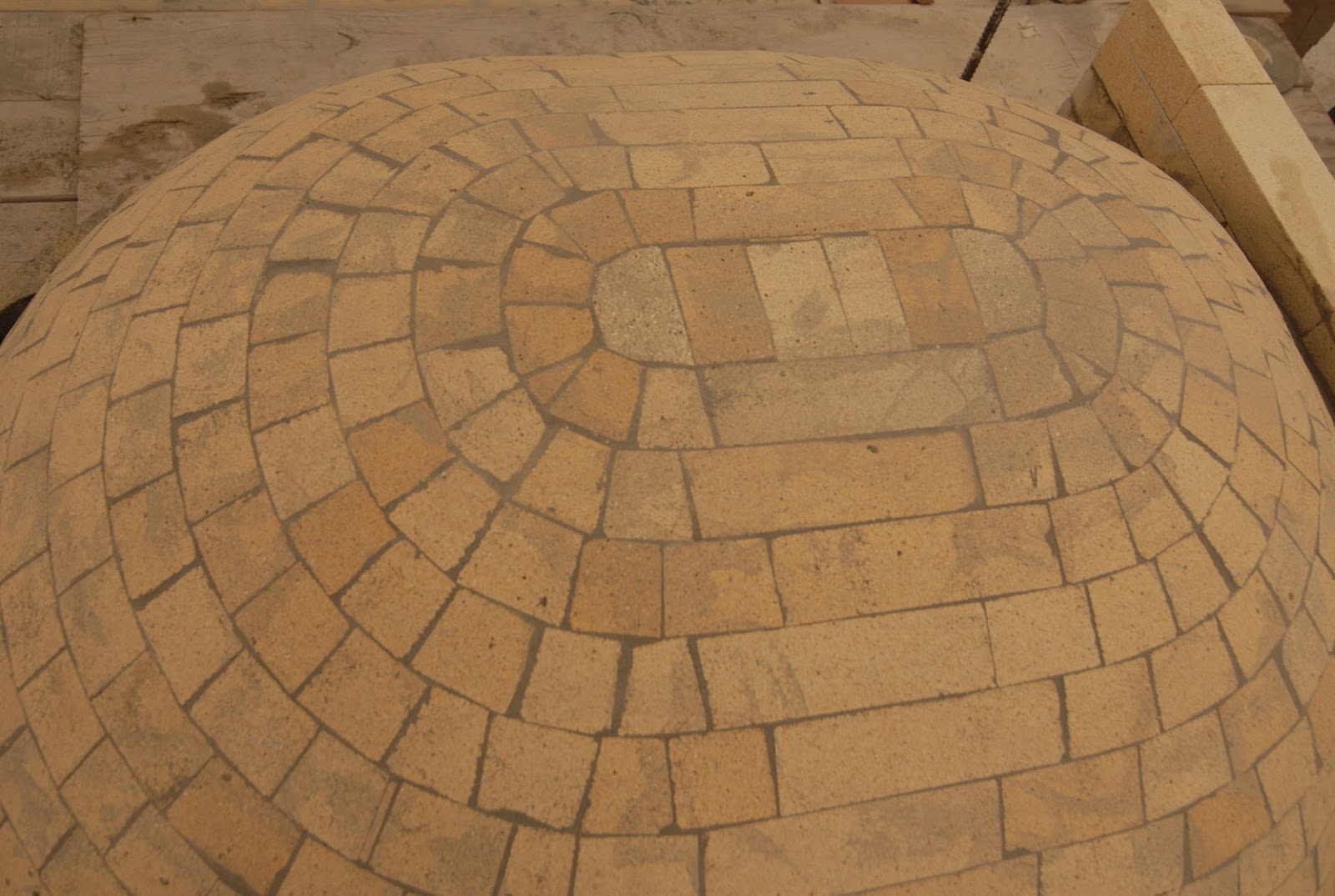
The long dome got us thinking about this 'stretch' version of the Pompeii dome being adaptable for not only narrow spaces but shallow spaces, with the mouth positioned on the long side rather than the end.

This oven is 48" wide and 60" long in the interior or think of it as a 48" dome with a 12" straight section in between the two halves of the dome spliced into the adjoining bricks for strength.
Tim fitting keystone #1

The Roman keystones that close the final space at the top were actually easier to place than the classic eight-sided keystone of a round dome... but just as satisfying.

Friday, November 30, 2012

The Garden Stage


Imagine that you are the writer and director of a play or movie (no pressure).  In this case, the stage is your yard and the actors are the trees and shrubs and flowers.  Generally speaking, your company has some veterans, actors who have been around awhile but admittedly can play only the roles they are used to.  These are the trees.  You may have one or two stubborn actors; scraggly trees, harassed by deer or ice-broken, who have lost the energy to grow. You’d like to cut them from the company because they mess up their (or your) lines and need to retire but they don’t know it. 
If you’re fortunate you have at least one stellar actor who seems to hold the whole company together no matter what audience shows up and now matter what script you throw at it.  This is your sentinel tree or your specimen tree, the hallmark of your productions.  You might have some young ones who are coming up in the ranks and may someday challenge the veteran for its place, but for now they are saplings standing on the sidelines.
Next come the supporting actors, the shrubbery, as they might be called.  They require few lines but need some pampering and care to perform at their best.  Do not underestimate their value.  There’s many the leading actor that can credit the best performances to the roles of the supporting actors.  You may also think of groups of supporting actors as playing a significant role in the unfolding script that you have written (or are desperately trying to write before the production deadline).
Then you’ve got the extras, let’s call them the color.  Crowds of silent or murmuring perennials or annuals that give the whole shebang flavor.  Sometimes we bring in extra extras when the script needs last-minute help. This occurs around the end of June and coincides with the clearance sales at nurseries. A drive-by pick-up of extras can be a wonderful, curative event.
No production is complete without lighting. A perfect opening scene might include a light fog at sunrise, shafts of sun landing on the blooming shrubs, the backdrop of forest reduced to a soft dark-green veil. Hopefully, sunset lights the garden with the finality of a romantic kiss or a cathartic reunion.
Last year you launched a drama.  After a bright and colorful opening (daffodils, forsythias, lilacs), the script took an ominous turn as weather and somber dialogue had the audience wonder if a tragedy was in store.  However the cast turned out in the end with a rousing (and long) finale that left you inspired and exhausted.
Next year it’s a mystery piece.  Walk around the garden now and pick up the clues.  Step back inside, check the script and perhaps make some last-minute changes in the cast. Break a stick!
Posted in the interest of a 'whole' approach to designing outdoor space. For more on landscape design go to: theconsciousgardener.blogspot.com  and northstarstoneworks.com

Thursday, November 29, 2012

Longer Brick Ovens

Strictly square or round brick ovens, although having qualities that appeal to different users, are not the only shape possible.  The 'squirrel tail' Appalacian style oven was built at a masons' workshop (Backyard Oven Workshop with Peter Moore
MHA Annual Meeting, 2006.

Bricks set dry on 'Foamglass' and perimeter of oven scribed
I am currently building an elongated Pompeii dome oven in St. Charles, MO.
Sometimes, space constraints require that the shape of ovens be modified and with careful consideration this can be accommodated.


 The 'stretcher' bricks will be brought up to an elongated keystone but otherwise the oven progresses the same as circular domes with each chain being locked into place by the angles of the bricks.

The arch form and mouth arch come next...
End of Day Two

Wednesday, November 28, 2012

Visual Metaphor


The arrangement of plants and objects in the landscape can be metaphoric. A metaphor: that is when something IS the representation of the intended meaning, such as “that tree is my grandfather”.  If that tree was “like” my grandfather, we’d have a simile; enough of English 101.
Deciding to use an object as a metaphor relieves the landscape designer of finding a literal representation. Literal representations, such as garden gnomes, fairies, angels, or Venus’, attach the viewer too securely to one meaning.
Rocks, shrubs, trees (dead or alive) that suggest mythic forms create a stronger and broader effect on the viewer.  A shadowed doorway into a dark woodland cannot avoid suggesting a journey into the subconscious.  This is clearly a different effect than the loud direct message sent by the entrance to the carnival fun-house.
 When designing landscapes, interior spaces, and in the case of TBO, brick ovens, I look for metaphoric opportunities.  These are arrangements that suggest larger visual meaning.  Color, texture, patina can evoke a response from the viewer/owner that is signaled on a non-obvious level.   We tend to really enjoy this (if it's done well and consciously...paradoxically).

Each project I design gives me the chance to employ metaphor.  Metaphor is my friend.

Brick Oven Refinement

Every brick oven I build has some refinement; one advantage of being a custom brick oven builder.

The refinement added to this recent brick oven provides a large work space (when handling baked or roasted products) under the throat of the oven.  It harks back to the true Pompeii style ovens (pictured at bottom from my visit to Pompeii, Italy).

Modern-traditional brick ovens like the ones I build also need more-than-adequate fire-proofing from the surroundings.  In addition to steel framing and cement board enclosure of the oven volume, I surround the oven with nearly three times the industry standard in refractory insulation.  It's an easy equation to see that heat retained is both safe heat and long heat.

bakery-size oven design modeled after Pompeii
The original Pompeii ovens had a shelf that spanned the full width of the bakery and were under the throat and flue of the oven chimney.  I have conjectured (without meticulous archeology) that these lateral spaces were useful for handling quantities of bread on the way into the oven and then out of the oven.

I also imagine that the bakery ovens of Pompeii never cooled down until (ironically) after Vesuvius buried the town in 79 CE (Common Era also A.D.).

The bakery oven pictured below is one of the  more decorative brick ovens uncovered when Pompeii was excavated.


Tuesday, November 27, 2012

Then and Now


This ruin in County Clare, Ireland on a 'soft' morning in March was photographed by me just as one of the common local hares unconsciously ran towards me, stopped in its tracks and did an about-face.

I have found that people have a attraction (perhaps even a fascination) with old stuff.
In the world of stone, ruins offer some of the most attractive examples of what is left when the beams, rafters, and roofs have fallen.


The garden house constructed by me this past summer incorporates some of the visual qualities found in northern European stone buildings.


The brick oven in Audrix, France, which I get to visit when I'm in the Perigord,  is an example of local stone work incorporating worked limestone and rough fieldstone with concealed mortar joints.

Having cultural models like these adds to my visual vocabulary when designing brick ovens, stone buildings, and outdoor environments that give the owners a taste of the 'old stuff'.

Monday, November 26, 2012

The Symbolic Power of Objects


We instinctively know that when we see a single standing stone, it marks something (or so we believe).  Two posts create a gateway, three a family, four a room, five a counsel and many, well many are likely to be grouped in subgroups of one, two, three, and four.
If we contemplate the one stone, we sense authority and before long a paternal, maternal, or authority impression of the stone creeps into our heads.  The two stones or posts appear to be guarding an entrance and we approach knowing that we may have to ask permission to pass.  Three (let’s say of varying sizes) gets us identifying father, mother, and child.  And four, depending on their placement will present an organized entity whether they enclose a space or provoke you to ask (as you would a panel of judges, sages, or grandparents), “what do you want?”
We do not need to work hard to perceive the symbolic nature of objects; their meaning will jump out at us if we let it.
Cliff-face houses in Ravello, Italy
As a stone mason and landscape designer, my eye/mind is always on the prowl for visual prey.  This carnivorous approach to the world around feeds itself; the more I notice, the deeper I can see.
Applying the strength of observation gained from this exercise helps when I am challenged to design in an environment that is new or strange.  Call it visual survival skill.
It also connects me to the anonymous ancient designers of the stone age through the present, not a bad way to time-travel.